The CSE Framework: Clarity → Structure → Execution for Your Business
A Practical Model for Sustainable Business Growth.
Mohammad Nozibul Haque, AI Tools
3/17/20264 min read
Introduction
In the dynamic and often unpredictable business landscape of Bangladesh and emerging markets, most entrepreneurs and business leaders face a common challenge: they are busy, but not necessarily effective. Despite hard work, long hours, and continuous effort, growth often remains inconsistent, fragile, or entirely stagnant.
Why does this happen?
The answer lies not in effort, but in direction, design, and discipline.
At Nozibul's Strategic Growth Advisory, we have observed that sustainable business growth is not a result of random success or isolated decisions. It is the outcome of a deliberate system—a framework that aligns vision, organizes resources, and ensures consistent execution.
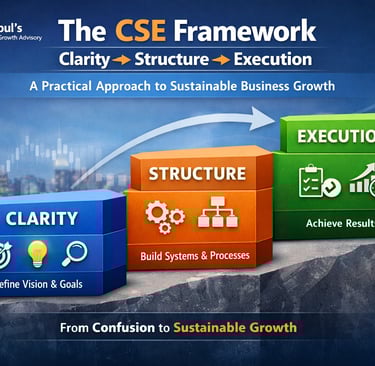
This is where the CSE Framework (Clarity → Structure → Execution) becomes essential.
The CSE Framework is a practical, field-tested approach designed to help businesses move from confusion to control and from survival to scalable growth. It is particularly relevant for entrepreneurs, SME owners, and growth-stage companies in Bangladesh who seek to build resilient and high-performing organizations.
The Problem: Why Most Businesses Fail to Scale
Before understanding the framework, it is important to diagnose the root causes of stagnation.
Most businesses struggle due to three fundamental gaps:
Lack of clarity about direction, positioning, and priorities
Weak or absent structure in systems, processes, and roles
Inconsistent execution driven by poor accountability and discipline
These gaps create a cycle where business owners are constantly firefighting instead of building.
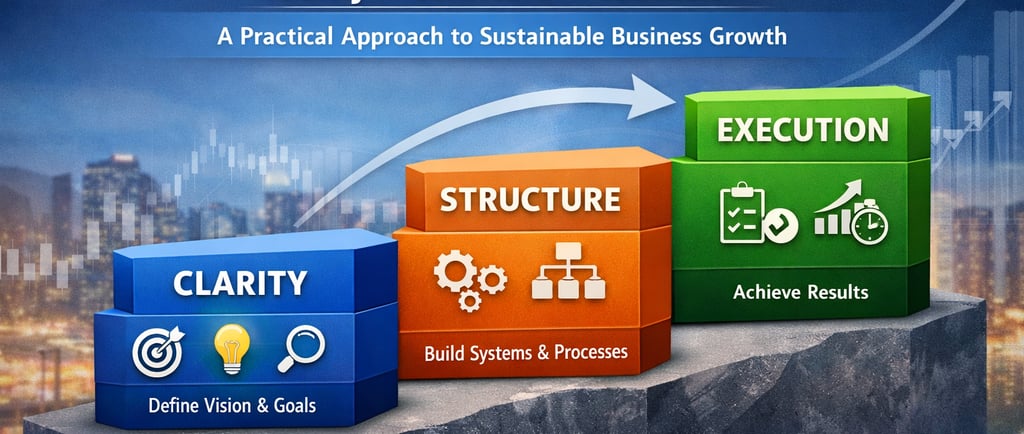
The CSE Framework addresses these issues in a sequential and integrated manner.
Phase 1: Clarity – Defining Direction and Focus
Clarity is the foundation of all sustainable growth. Without clarity, even the best strategies and teams fail to deliver results.
What is Clarity?
Clarity is the process of defining:
Vision – Where the business is going
Mission – Why the business exists
Target Market – Who the business serves
Value Proposition – Why customers choose you
Strategic Priorities – What matters most right now
Why Clarity Matters
In many businesses, leaders attempt to scale without answering fundamental questions:
What problem are we truly solving?
Who is our ideal customer?
What differentiates us from competitors?
What should we stop doing?
Without clear answers, businesses become reactive rather than strategic.
Key Components of Clarity
1. Strategic Positioning
Identify your niche and competitive advantage.
2. Customer Definition
Move from “everyone is my customer” to a sharply defined target audience.
3. Goal Alignment
Set measurable and time-bound objectives (e.g., revenue, market share, expansion).
4. Priority Mapping
Focus on the 20% of activities that generate 80% of results.
Practical Example
A mid-sized e-commerce business in Bangladesh may be selling hundreds of products without a clear niche. Through clarity, they may realize:
Their strongest segment is lifestyle accessories
Their highest-margin products are premium items
Their ideal customer is urban middle-class professionals
This clarity allows them to focus resources and messaging effectively.
Phase 2: Structure – Building the System
Once clarity is established, the next step is structure. This is where many businesses fail. They have ideas but lack systems.
What is Structure?
Structure refers to the design of the organization that supports growth. It includes:
Processes
Systems
Roles and responsibilities
Performance metrics
Why Structure Matters
Without structure:
Work becomes dependent on individuals, not systems
Scaling becomes chaotic
Quality becomes inconsistent
Decision-making becomes slow and unclear
Structure transforms a business from being founder-dependent to system-driven.
Key Elements of Structure
1. Organizational Design
Define clear roles, reporting lines, and responsibilities.
2. Standard Operating Procedures (SOPs)
Document repeatable processes for consistency and efficiency.
3. Performance Management Systems
Use KPIs (Key Performance Indicators) to measure progress.
4. Technology Integration
Implement tools for CRM, finance, operations, and communication.
5. Decision Frameworks
Establish rules for faster and more consistent decision-making.
Practical Example
Consider a consulting or service business where the founder handles everything—from sales to delivery.
Through structure:
Sales processes are standardized
Delivery methodologies are documented
A team is assigned specific roles
KPIs are introduced for performance tracking
This reduces dependency on the founder and increases scalability.
Phase 3: Execution – Turning Plans into Results
Clarity and structure are meaningless without execution. Execution is where strategy meets reality.
What is Execution?
Execution is the disciplined implementation of plans, supported by accountability and continuous monitoring.
Why Execution Fails
Many businesses fail at execution due to:
Lack of accountability
Poor communication
Inconsistent follow-up
Absence of performance tracking
Execution is not about working harder—it is about working systematically.
Core Principles of Execution
1. Accountability Systems
Every task must have an owner.
2. Regular Review Mechanisms
Weekly and monthly reviews ensure alignment and progress.
3. Data-Driven Decisions
Use metrics to guide actions, not assumptions.
4. Feedback Loops
Learn quickly and adapt continuously.
5. Execution Rhythm
Establish a consistent cadence of planning, action, and review.
Practical Example
A business may set a goal to increase revenue by 30%.
Execution requires:
Breaking the goal into monthly and weekly targets
Assigning responsibilities to team members
Tracking sales performance daily
Adjusting strategies based on real-time data
Without execution discipline, even the best strategies fail.
The Integration: How CSE Works as a System
The power of the CSE Framework lies in its integration.
Clarity defines what to do
Structure defines how to do it
Execution ensures it gets done
These three components are interdependent.
If one fails, the entire system weakens:
Clarity without structure leads to confusion
Structure without execution leads to stagnation
Execution without clarity leads to wasted effort
Sustainable growth occurs only when all three operate together.
Benefits of the CSE Framework
Organizations that implement the CSE Framework experience:
1. Strategic Focus
Reduced distractions and improved decision-making.
2. Operational Efficiency
Streamlined processes and better resource utilization.
3. Scalability
Ability to grow without chaos or dependency on individuals.
4. Accountability Culture
Clear ownership and performance-driven teams.
5. Predictable Growth
Improved forecasting and consistent results.
Application in the Bangladesh Context
The CSE Framework is particularly relevant for businesses in Bangladesh due to:
Rapid market changes
Increasing competition
Limited access to structured management practices
High dependency on founders
By adopting the CSE approach, local businesses can transition from informal operations to professionally managed organizations.
Implementation Roadmap
For businesses looking to implement the CSE Framework, the following roadmap can be applied:
Step 1: Diagnose Current State
Assess gaps in clarity, structure, and execution.
Step 2: Define Strategic Clarity
Establish vision, goals, and priorities.
Step 3: Build Core Structure
Develop systems, processes, and team roles.
Step 4: Establish Execution Discipline
Introduce KPIs, review systems, and accountability mechanisms.
Step 5: Continuous Improvement
Regularly refine strategies based on performance data.
Conclusion
Sustainable business growth is not accidental. It is engineered through disciplined thinking and structured action.
The CSE Framework—Clarity → Structure → Execution—provides a practical and powerful model for entrepreneurs and business leaders who want to move beyond survival and achieve long-term success.
In a world where uncertainty is constant, businesses that operate with clarity, build strong structures, and execute with discipline will always outperform those that rely on effort alone.
At Nozibul's Strategic Growth Advisory, the mission is clear: to help businesses transform into structured, scalable, and high-performing organizations using frameworks like CSE.
The question is no longer whether your business can grow.
The real question is: Are you ready to grow with clarity, structure, and execution?
Reach out anytime; let's work together.
© 2026. All rights reserved.
Trade License No. TRAD/DNCC/045510/2025
Office Address:
House No. 7/11, Block: C
Tajmahal Road, Mohammadpur,
Dhaka-1207
E-mail: nozibul.haque@gmail.com
Cell: +8801711081251