How to Stay Fit and Productive All Year: A Strategic Framework for Consistent High Performance
Learn how to stay fit and productive all year using a proven strategic framework. Build sustainable habits for consistent high performance and long-term success.
Mohammad Nozibul Haque & AI Tools
4/7/20262 min read
In today’s competitive and fast-paced world, the ability to stay fit and productive all year is a defining advantage. However, most individuals struggle with inconsistency—starting strong but losing momentum over time.
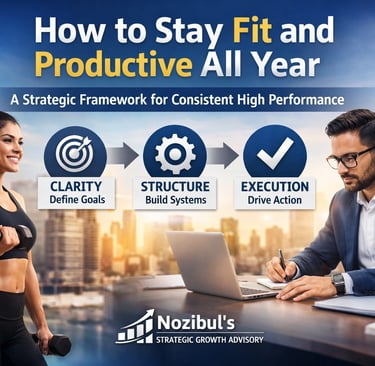
At Nozibul's Strategic Growth Advisory, we believe sustainable success is not accidental. It is built through a structured system—the CSE™ Framework: Clarity, Structure, and Execution.
This article provides a practical, system-driven approach to achieving year-round fitness and productivity.
Why Staying Fit and Productive All Year Is Difficult
Many people fail to maintain year-round productivity and fitness due to:
Lack of clear goals
Absence of structured routines
Overdependence on motivation
Poor energy management
This results in cycles of burnout, inconsistency, and underperformance.
Key Insight:
Without a system, consistency is impossible.
The CSE™ Framework for Sustainable High Performance
The CSE™ Framework provides a strategic model to ensure consistent high-performance habits:
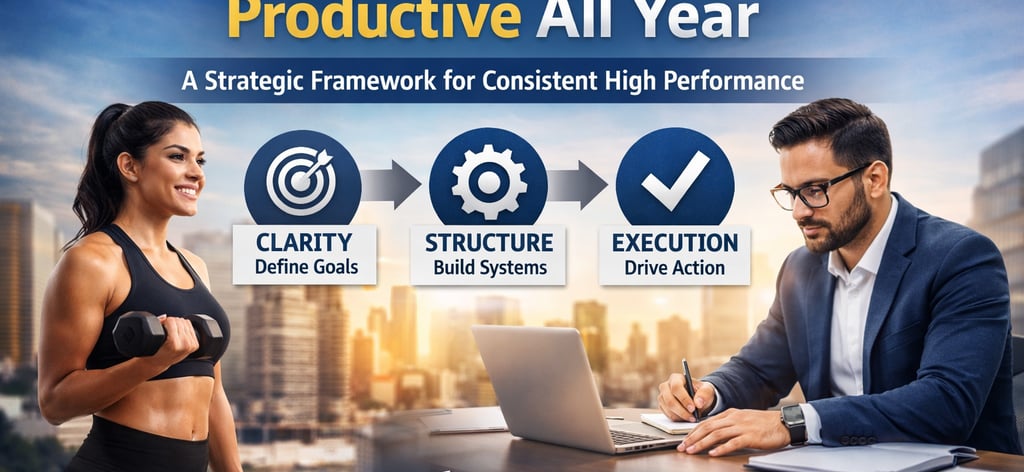
Clarity – Define your direction
Structure – Build repeatable systems
Execution – Maintain disciplined action
Step 1 – Clarity: Define Fitness and Productivity Goals
Clarity transforms intention into measurable outcomes.
Define Your Fitness Goals
Improve energy and stamina
Build strength and endurance
Maintain consistent physical activity
Define Your Productivity Goals
Focus on high-impact work
Improve deep work capacity
Increase output quality
Step 2 – Structure: Build a Daily and Weekly System
To maintain productivity and fitness year-round, you must eliminate randomness.
Daily Routine for Success
Morning Routine (Energy Activation)
Hydration and light movement
Exercise (20–45 minutes)
Set top 3 priorities
Work Routine (Deep Work Blocks)
60–90 minute focused sessions
Eliminate distractions
Scheduled breaks
Evening Routine (Recovery & Reflection)
Light activity or walk
Plan next day
Optimize sleep (7–8 hours)
Weekly Productivity and Fitness Plan
Fitness Plan
3 days strength training
2 days cardio
1 recovery day
1 rest day
Productivity Plan
Weekly planning session
Define key outcomes
Time-block important tasks
Environment Optimization
Prepare workout space in advance
Maintain a distraction-free workspace
Use tools that enhance focus
Key Insight:
A well-designed system reduces reliance on willpower.
Step 3 – Execution: Build Consistency and Discipline
Execution determines results.
Establish Non-Negotiable Habits
To build high performance habits, commit to:
Daily movement or exercise
Focused deep work sessions
Reflection or learning
Follow the 80% Consistency Rule
Avoid perfectionism
Maintain consistency even at reduced intensity
Recover quickly from missed days
Track Your Performance
Measure:
Workout frequency
Hours of deep work
Energy levels
Weekly progress
Tracking ensures continuous improvement.
Build a High-Performance Identity
Shift from:
“I try to be productive.”
➡️ “I execute consistently every day.”
The Connection between Fitness and Productivity
Your physical health directly influences your professional performance.
Benefits of Staying Fit:
Improved focus and cognitive ability
Higher energy levels
Reduced stress and burnout
Strategic Insight:
Fitness is not separate from productivity—it is a performance driver.
Common Mistakes to Avoid
1. Relying on Motivation
Solution: Build systems
2. Overloading Your Schedule
Solution: Focus on essential actions
3. Ignoring Recovery
Solution: Prioritize sleep and rest
4. Lack of Review
Solution: Conduct weekly evaluations
A Practical Year-Round Success Blueprint
Daily:
Exercise (30–60 minutes)
2–4 hours deep work
Reflection
Weekly:
Plan priorities
Review progress
Monthly:
Assess fitness growth
Evaluate productivity outcomes
Mindset for Long-Term Consistency
To sustain year-round productivity and fitness, shift your mindset:
Discipline over motivation
Systems over goals
Consistency over intensity
Outcomes over activity
Conclusion: Build a System, Not Just Goals
To truly stay fit and productive all year, you need more than intention—you need a system.
The CSE™ Framework ensures:
Clear direction
Structured execution
Sustainable results
Final Thought
You do not rise to the level of your goals.
You fall to the level of your systems.
If you build the right system, consistent high performance becomes inevitable.
Reach out anytime; let's work together.
© 2026. All rights reserved.
Trade License No. TRAD/DNCC/045510/2025
Office Address:
House No. 7/11, Block: C
Tajmahal Road, Mohammadpur,
Dhaka-1207
E-mail: nozibul.haque@gmail.com
Cell: +8801711081251