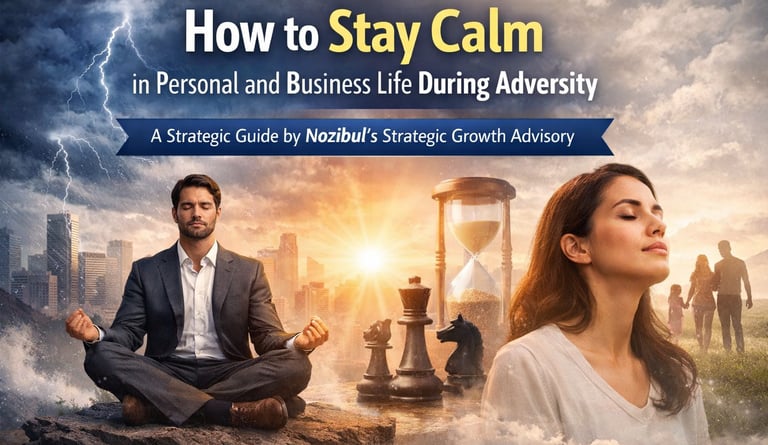
How to Stay Calm in Personal and Business Life During Adversity
A Strategic Guide by Nozibul’s Strategic Growth Advisory. Learn how to stay calm during adversity in both personal and business life using proven strategies, mindset frameworks, and leadership discipline for long-term success.
Mohammad Nozibul Haque & AI Tool
4/9/20263 min read
Introduction: Calm is Not Weakness—It is Strategy
Adversity is inevitable. Whether it appears as financial pressure, business uncertainty, family stress, or unexpected disruptions, every individual and organization faces turbulence. What separates high performers, resilient leaders, and successful entrepreneurs from the rest is not the absence of adversity—but their ability to remain calm within it.
Calmness is not passive acceptance. It is a strategic advantage. It allows clarity of thought, precision in decision-making, emotional stability, and long-term vision—all of which are critical in both personal and professional domains.
At Nozibul’s Strategic Growth Advisory, we view calmness as a core leadership competency, not just a personality trait. It can be developed, systemized, and applied consistently through the right framework.
Understanding Adversity: The Dual Battlefield
Adversity affects two critical dimensions simultaneously:
1. Personal Life Impact
Emotional instability
Anxiety and overthinking
Relationship strain
Health deterioration
2. Business Life Impact
Poor decision-making under pressure
Loss of strategic direction
Team demotivation
Financial missteps
When these two dimensions collide, individuals often enter a reactive mode—leading to chaos, not control.
The solution lies in structured calmness.
The Science of Staying Calm Under Pressure
When faced with adversity, the human brain activates the fight-or-flight response. This survival mechanism, while useful in danger, becomes counterproductive in modern business and life challenges.
Key effects include:
Reduced logical thinking
Emotional decision-making
Impulsive reactions
Short-term focus
To counter this, one must intentionally activate the prefrontal cortex, responsible for rational thinking and strategic planning. This is where discipline and frameworks come into play.
The CSE™ Framework: Your Strategic Tool for Calmness
At Nozibul’s Strategic Growth Advisory, we apply the CSE™ Framework:
1. Clarity
2. Strategy
3. Execution
Let’s break down how this framework helps maintain calm in adversity.
Step 1: Clarity – Control Your Mind Before You Control the Situation
In adversity, confusion amplifies stress. Clarity reduces it.
Practical Techniques for Clarity:
Pause Before Reaction: Take 5–10 minutes to detach emotionally
Define the Real Problem: Separate facts from assumptions
Write It Down: Externalizing thoughts reduces mental overload
Ask Strategic Questions:
What is within my control?
What is the worst-case scenario?
What outcome do I want?
Clarity transforms chaos into a manageable structure.
Step 2: Strategy – Replace Emotion with Direction
Once clarity is established, the next step is to design a response.
Strategic Actions:
Prioritize Issues: Not all problems require equal attention
Break Down the Challenge: Divide into smaller, solvable parts
Scenario Planning: Prepare Plan A, B, and C
Consult Wisely: Seek advice from experienced individuals, not emotional crowds
In business, strategy prevents costly mistakes.
In personal life, it prevents emotional damage.
Step 3: Execution – Calm Action Creates Momentum
Calmness is reinforced through action.
Execution Principles:
Start small but act immediately
Focus on consistency, not perfection
Track progress daily
Avoid overconsumption of negative information
Action reduces anxiety. Inaction increases it.
Emotional Discipline: The Foundation of Calmness
Calm individuals are not emotionless—they are emotionally disciplined.
How to Build Emotional Discipline:
Practice mindfulness or prayer
Maintain a daily routine
Limit exposure to negativity (news, toxic people)
Focus on solutions, not blame
Remember:
You cannot control events, but you can control your response.
Leadership Under Pressure: Calmness as Influence
In business, your calmness directly influences your team.
A calm leader:
Builds trust
Maintains team morale
Encourages rational thinking
Prevents panic-driven decisions
A reactive leader:
Spreads fear
Creates confusion
Damages long-term growth
Your emotional state is contagious. Choose it strategically.
Practical Tools to Stay Calm Daily
1. The 90-Second Rule
When triggered, wait 90 seconds before responding. This allows emotional chemicals to settle.
2. Controlled Breathing Technique
Inhale for 4 seconds
Hold for 4 seconds
Exhale for 6 seconds
Repeat 5 times to reset your nervous system.
3. The “Control Circle” Method
Divide your concerns into:
What you can control
What you cannot
Focus only on the first.
4. Daily Reflection
Ask yourself every night:
What did I handle well today?
Where did I react emotionally?
How can I improve tomorrow?
Common Mistakes During Adversity
Avoid these critical errors:
Overthinking without action
Seeking validation from too many sources
Making decisions in emotional peaks
Ignoring health and sleep
Trying to control everything
These behaviors intensify instability.
Building Long-Term Resilience
Calmness is not a one-time effort—it is a system.
Develop Resilience Through:
Continuous learning
Strong support networks
Financial planning
Physical health discipline
Spiritual or mental grounding
Resilience ensures that adversity becomes a temporary challenge, not a permanent setback.
Business Application: Calmness Drives Strategic Growth
Organizations that remain calm during crises:
Adapt faster
Innovate better
Retain customers and employees
Sustain long-term profitability
Calmness is not just emotional—it is economic.
Personal Life Application: Protecting What Matters Most
In personal life, calmness:
Strengthens relationships
Improves health
Enhances decision-making
Creates inner peace
Without calmness, success loses its meaning.
Final Thought: Calm is a Competitive Advantage
In a world driven by urgency, noise, and pressure, calmness stands out as a rare and powerful asset.
It is not about avoiding adversity—it is about mastering yourself within it.
At Nozibul’s Strategic Growth Advisory, we believe:
“Clarity creates calm. Strategy sustains it. Execution proves it.”
Reach out anytime; let's work together.
© 2026. All rights reserved.
Trade License No. TRAD/DNCC/045510/2025
Office Address:
House No. 7/11, Block: C
Tajmahal Road, Mohammadpur,
Dhaka-1207
E-mail: nozibul.haque@gmail.com
Cell: +8801711081251