
From Job Seeker to Entrepreneur: Applying the CSE (Clarity → Structure → Execution) Framework to Build an Entrepreneurial Mindset
Applying the CSE (Clarity → Structure → Execution) Framework to Build an Entrepreneurial Mindset
Mohammad Nozibul Haque, AI Tools
3/25/20264 min read
In today’s rapidly evolving economic landscape, the traditional career path of securing a stable job and climbing the corporate ladder is no longer the only—or even the most sustainable—route to success. Across Bangladesh and globally, a quiet but powerful shift is underway: individuals are moving from job seekers to value creators.
This transition, however, is not merely about starting a business. It is fundamentally about transforming your mindset—from dependency to ownership, from task execution to problem-solving, and from income earning to value generation.
The question is, how do you make this shift effectively and sustainably?
The answer lies in a structured approach. This is where the CSE Framework (Clarity → Structure → Execution) becomes a powerful tool to guide your transformation.
1. Understanding the Mindset Shift: Job Seeker vs Entrepreneur
Before diving into the framework, it is essential to understand the psychological and strategic differences between a job seeker and an entrepreneur.
A job seeker typically:
Focuses on finding opportunities
Waits for instructions
Trades time for money
Avoids risk
An entrepreneur, on the other hand:
Creates opportunities
Takes initiative
Builds systems that generate value
Manages and leverages risk
This shift is not automatic. It requires intentional thinking, disciplined action, and a structured roadmap.
2. The CSE Framework: A Strategic Roadmap
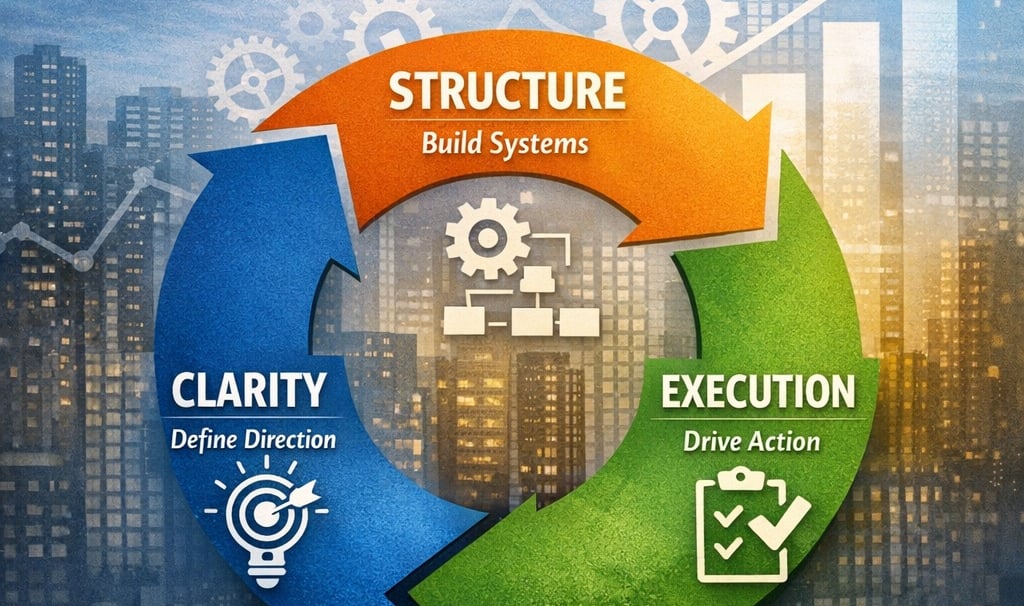
The CSE Framework—Clarity, Structure, Execution—is a practical methodology designed to help individuals move from confusion to control and from intention to impact.
Let us break down how each component contributes to building an entrepreneurial mindset.
3. CLARITY: Defining Your Direction
Clarity is the foundation of all entrepreneurial success. Without clarity, effort becomes scattered, and results remain inconsistent.
3.1 Identify Your “Why.”
Ask yourself:
Why do I want to become an entrepreneur?
Is it financial freedom, independence, impact, or legacy?
Your “why” will serve as your internal engine during difficult times.
3.2 Discover Your Value Proposition
Entrepreneurship begins with value creation, not product creation.
What problems can you solve?
Who are the people facing these problems?
Why should they choose you?
In Bangladesh, for example, there are massive opportunities in:
E-commerce logistics
Skill-based education
Agri-tech solutions
SME digital transformation
Your goal is to identify a gap where your skills and market demand intersect.
3.3 Assess Your Current Reality
Clarity also requires honesty:
What skills do you currently have?
What resources (time, money, and networks) are available?
What constraints are you facing?
This realistic self-assessment prevents overconfidence and helps you plan effectively.
4. STRUCTURE: Building Your System
After establishing clarity, the next step is to create a structure that fosters consistent progress.
Entrepreneurship is not chaos—it is organized execution.
4.1 Develop a Simple Business Model
You don’t need a complex plan to start. Focus on:
Target customer
Problem
Solution
Revenue stream
For example:
Customer: Urban young professionals
Problem: Lack of time for shopping
Solution: Curated e-commerce platform
Revenue: Product margin
4.2 Create a Skill Development Plan
To transition from job seeker to entrepreneur, you must upgrade your capabilities.
Key entrepreneurial skills include:
Sales and negotiation
Digital marketing
Financial literacy
Communication and leadership
Instead of random learning, create a focused skill roadmap aligned with your business idea.
4.3 Design Your Daily and Weekly Systems
Entrepreneurs win through consistency, not intensity.
Daily: 2–4 hours of focused work on your venture
Weekly: Review progress and adjust strategy
Monthly: Measure outcomes (sales, leads, growth)
Structure reduces decision fatigue and increases productivity.
4.4 Build a Support Ecosystem
You cannot grow alone. Build:
Mentors
Peer networks
Industry connections
In Bangladesh, communities like startup groups, business forums, and online marketplaces can significantly accelerate your journey.
5. EXECUTION: Turning Plans into Results
Clarity without action is useless. Structure without execution is wasted effort.
Execution is where transformation truly happens.
5.1 Start Small, Start Now
One of the biggest mistakes aspiring entrepreneurs make is waiting for the “perfect moment.”
There is no perfect moment.
Start with:
A minimum viable product (MVP)
A small target market
A simple sales strategy
For example, instead of building a full e-commerce website, start by selling through Facebook or WhatsApp.
5.2 Embrace Imperfection
Your first attempt will not be perfect—and that is acceptable.
Entrepreneurship is a process of:
Testing
Learning
Improving
Each failure is data, not defeat.
5.3 Focus on Revenue Early
Many beginners focus on branding, logos, and design. While important, these are secondary.
Your primary focus should be
Getting customers
Generating revenue
Validating demand
Revenue is the strongest proof of value.
5.4 Build Discipline and Consistency
Execution is not about motivation—it is about discipline.
Show up every day
Take measurable actions
Track your progress
Consistency compounds over time, leading to exponential results.
6. Overcoming Common Barriers
Transitioning to entrepreneurship is not straightforward. You will face obstacles.
6.1 Fear of Failure
Understand that failure is part of the process. The real risk is not trying at all.
6.2 Financial Pressure
Start part-time if necessary. Maintain your job while building your business until it becomes stable.
6.3 Social Expectations
Many societies, including Bangladesh, still perceive entrepreneurship as risky.
Stay focused on your long-term vision rather than short-term opinions.
7. The Entrepreneurial Identity Shift
Ultimately, the transition is not just about what you do—it is about who you become.
You move from:
Employee → Owner
Consumer → Creator
Follower → Leader
This identity shift is reinforced through daily actions aligned with the CSE framework.
8. Practical Action Plan (CSE in 30 Days)
To make the shift actionable, here is a simple 30-day roadmap:
Week 1: Clarity
Define your “why.”
Identify one problem to solve
Research your target market
Week 2: Structure
Outline a simple business model
Create a basic action plan
Start learning one key skill
Week 3: Execution
Launch a basic version of your idea
Reach out to potential customers
Make your first sale
Week 4: Optimization
Analyze results
Improve your offer
Plan for scaling
9. Conclusion: Your Transformation Starts Today
Becoming an entrepreneur is not reserved for a select few. It is a deliberate choice backed by structured action.
The CSE Framework—Clarity, Structure, Execution—provides a practical pathway to move from uncertainty to ownership.
Clarity gives you direction
Structure gives you stability
Execution gives you results
If you commit to this process, you will not only build a business—you will build a new version of yourself.
The journey from job seeker to entrepreneur does not begin with capital.
It begins with a decision.
Make that decision today.
Reach out anytime; let's work together.
© 2026. All rights reserved.
Trade License No. TRAD/DNCC/045510/2025
Office Address:
House No. 7/11, Block: C
Tajmahal Road, Mohammadpur,
Dhaka-1207
E-mail: nozibul.haque@gmail.com
Cell: +8801711081251