
Financial Freedom Is Not a Luxury; It Is a Human Right
Applying the CSE (Clarity → Structure → Execution) Framework for Sustainable Financial Independence
Mohammad Nozibul Haque and AI Tools.
3/20/20264 min read
In contemporary society, financial freedom is often portrayed as an elite aspiration—reserved for entrepreneurs, high-income professionals, or those with inherited wealth. This perception is not only misleading but also fundamentally unjust. Financial freedom is not a luxury; it is a basic human right. It underpins dignity, autonomy, and the ability to make life choices without constant economic anxiety.
For individuals in Bangladesh and across the world, achieving financial freedom is both a necessity and a strategic pursuit. However, a lack of direction, fragmented knowledge, and inconsistent execution frequently obscure the path. This is where a disciplined framework becomes indispensable.
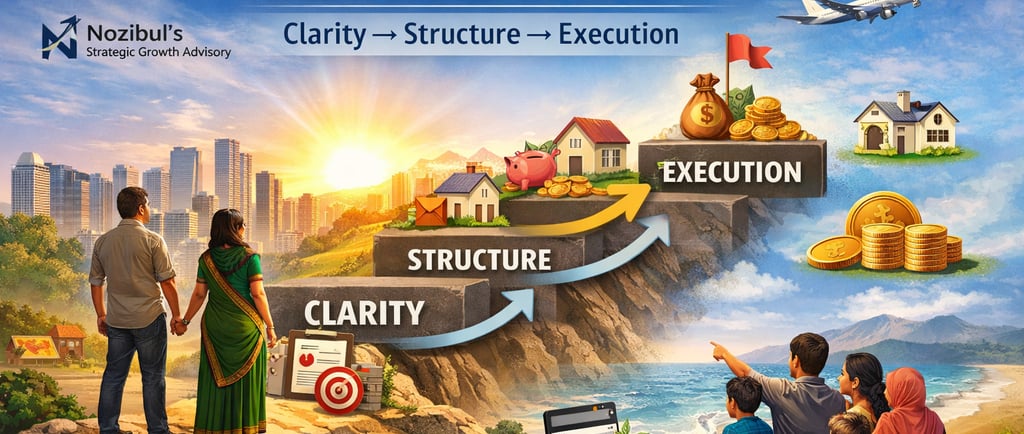
The CSE Framework—Clarity → Structure → Execution, developed by Nozibul's Strategic Growth Advisory, provides a practical, scalable, and actionable roadmap for achieving financial freedom regardless of starting point.
1. Understanding Financial Freedom as a Human Right
Financial freedom is not merely about wealth accumulation. It is about control over your financial life—the ability to meet obligations, absorb shocks, and pursue opportunities without dependency or fear.
At its core, financial freedom ensures:
Security: Ability to handle emergencies without debt traps
Choice: Freedom to choose career, lifestyle, and location
Dignity: Independence from financial exploitation or vulnerability
Legacy: Capacity to support future generations
In Bangladesh, where a large portion of the population lives with financial uncertainty, redefining financial freedom as a right is crucial. It shifts the narrative from aspiration to necessity—and from privilege to responsibility.
2. The CSE Framework: A Strategic Pathway
The journey to financial freedom must be intentional. Random efforts—saving sporadically, investing without knowledge, or chasing trends—rarely yield sustainable outcomes.
The CSE Framework introduces a disciplined progression:
Clarity → Structure → Execution
Each stage builds upon the previous one, ensuring alignment, efficiency, and measurable progress.
3. Stage One: Clarity
“If you are not clear about your financial destination, any path will seem acceptable.”
Clarity is the foundation. Without it, individuals remain trapped in cycles of income and expense without meaningful progress.
3.1 Define Financial Freedom for Yourself
Financial freedom is subjective. For a corporate employee in Dhaka, it may mean having passive income equal to monthly expenses. For a small business owner, it may mean scaling operations without debt pressure.
Ask:
What is my monthly expense requirement?
At what income level will I feel secure?
What lifestyle do I want in 5, 10, and 20 years?
3.2 Assess Your Current Financial Position
You cannot improve what you do not measure. Conduct a personal financial audit:
Total income sources
Fixed and variable expenses
Assets (savings, property, investments)
Liabilities (loans, credit obligations)
This creates a baseline from which progress can be tracked.
3.3 Identify Financial Leaks
In Bangladesh, common financial leakages include:
Unplanned spending
High mobile/internet costs
Social pressure-driven expenses (events, gifts)
Poor debt management
Clarity requires honesty. Eliminating these leaks creates immediate improvement without increasing income.
3.4 Build a Financial Mindset
Financial freedom is as much psychological as it is practical. You must shift from:
Consumption → Creation
Short-term pleasure → Long-term stability
Dependency → Ownership
Without this mindset shift, no strategy will be sustained.
4. Stage Two: Structure
“Clarity without structure leads to frustration; structure converts vision into a system.”
Once clarity is achieved, the next step is to design a robust financial system.
4.1 Income Structure: Diversification Is Essential
Relying on a single income source is inherently risky. Structure your income into:
Active Income: Salary or business earnings
Side Income: Freelancing, consulting, small ventures
Passive Income: Investments, rental income, dividends
In Bangladesh, emerging opportunities include:
Freelancing platforms (IT, design, marketing)
E-commerce (Daraz, Facebook shops)
Digital services (consulting, coaching)
4.2 Expense Structure: Control and Optimization
Adopt a disciplined allocation model:
50–60%: Essential expenses
20–30%: Savings and investments
10–20%: Lifestyle and discretionary spending
This ensures that savings are not an afterthought but a priority.
4.3 Savings Structure: Build Safety First
Before investing aggressively, establish:
Emergency Fund: 6 months of living expenses
Liquidity Reserve: Easily accessible savings
In Bangladesh, this can be maintained through:
Bank savings accounts
DPS (Deposit Pension Schemes)
Mobile financial services (with caution)
4.4 Investment Structure: Grow Your Wealth
Once safety is ensured, focus on growth:
Stock market (with proper knowledge)
Mutual funds
Real estate (long-term perspective)
Small business investments
Avoid speculative behavior. Structured investing prioritizes consistency over quick gains.
4.5 Risk Management
Financial freedom is incomplete without protection:
Health insurance
Life insurance
Diversified asset allocation
Unexpected events should not derail your financial journey.
5. Stage Three: Execution
“Execution is the bridge between intention and outcome.”
Most individuals fail not due to lack of knowledge but due to lack of disciplined execution.
5.1 Start Small but Start Immediately
Do not wait for perfect conditions. Begin with:
Saving 10–20% of income
Tracking expenses daily
Investing small amounts consistently
Consistency outweighs scale in the early stages.
5.2 Automate Financial Behavior
Automation reduces reliance on willpower:
Auto-transfer to savings accounts
Scheduled investments
Bill payment automation
This ensures discipline even during busy or stressful periods.
5.3 Build Income Growth Mechanisms
Execution must include income expansion:
Upskill continuously (digital, managerial, technical skills)
Network strategically
Transition from employee mindset to value creator mindset
In Bangladesh’s evolving economy, those who adapt skills quickly will dominate financially.
5.4 Monitor and Optimize
Set monthly and quarterly reviews:
Are savings targets being met?
Are investments performing as expected?
Are expenses under control?
Financial management is dynamic. Continuous optimization is necessary.
5.5 Develop Long-Term Discipline
Financial freedom is not achieved overnight. It requires:
Patience
Consistency
Resilience during setbacks
Avoid impulsive decisions driven by market hype or social influence.
6. Practical Application in the Bangladesh Context
While the principles of financial freedom are universal, execution must consider local realities.
6.1 Income Challenges
Many individuals face limited salary growth. Solution:
Develop parallel income streams
Leverage digital platforms
Explore global freelancing markets
6.2 Cultural and Social Pressures
Family and social expectations often drive unnecessary spending. Solution:
Set clear financial boundaries
Prioritize long-term stability over short-term approval
6.3 Limited Financial Literacy
A significant barrier is lack of knowledge. Solution:
Invest time in learning financial basics
Follow credible sources
Seek mentorship when possible
6.4 Access to Investment Opportunities
While options are growing, access remains uneven. Solution:
Start with available instruments (DPS, savings, small investments)
Gradually expand into diversified portfolios
7. Financial Freedom as a Collective Responsibility
Financial freedom is not only an individual pursuit—it is a societal imperative. When individuals are financially stable:
Families become stronger
Businesses grow sustainably
Economies become resilient
For Bangladesh, empowering individuals with financial freedom can significantly accelerate national development.
8. Conclusion: From Awareness to Action
Financial freedom must be reframed—from a distant dream to a structured, achievable objective grounded in discipline and strategy.
The CSE Framework—Clarity → Structure → Execution—provides a comprehensive roadmap:
Clarity defines your destination
Structure builds your system
Execution drives your results
This is not a theoretical model. It is a practical approach that, when applied consistently, can transform financial realities across income levels and geographies.
The responsibility now lies with you.
Not to wish for financial freedom—but to design it, build it, and execute it with precision.
Final Thought
Financial freedom is not reserved for the privileged few. It belongs to those who are willing to think clearly, act strategically, and execute consistently.
It is not a luxury. It is your right.
Reach out anytime; let's work together.
© 2026. All rights reserved.
Trade License No. TRAD/DNCC/045510/2025
Office Address:
House No. 7/11, Block: C
Tajmahal Road, Mohammadpur,
Dhaka-1207
E-mail: nozibul.haque@gmail.com
Cell: +8801711081251