
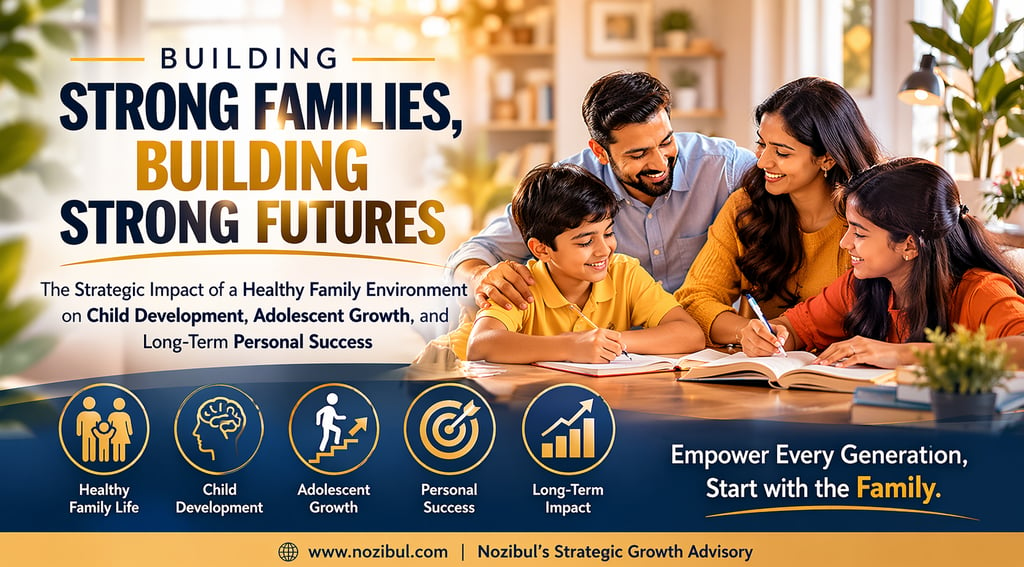
Building Strong Families, Building Strong Futures
The Strategic Impact of a Healthy Family Environment on Child Development, Adolescent Growth, and Long-Term Personal Success.
Mohammad Nozibul Haque & AI Tools
4/18/20264 min read
Introduction: Why Family Still Matters More Than Ever
In an era defined by rapid technological advancement, shifting social structures, and increasing economic pressures, one constant remains foundational to human development: the family. While education systems, digital platforms, and peer networks influence children and adolescents, the family environment remains the most powerful and enduring force shaping long-term personal and societal outcomes.
For leaders, parents, and policymakers alike, understanding the strategic importance of a sound family life is not just a moral or emotional consideration—it is a critical growth lever. At Nozibul’s Strategic Growth Advisory, we view family as the primary ecosystem of human capital development, where values, behaviors, and capabilities are formed.
This blog explores how a healthy family environment impacts child and adolescent development and how it drives long-term personal success, family sustainability, and even broader economic growth.
1. Defining a Healthy Family Environment
A “sound” or healthy family life is not defined by wealth, status, or perfection. Instead, it is characterized by stability, emotional security, communication, and intentional growth practices.
Core Elements of a Strong Family System:
Emotional Safety: Children feel loved, valued, and secure
Consistent Structure: Clear rules, routines, and expectations
Positive Communication: Open dialogue without fear or suppression
Value-Based Living: Ethical behavior modeled consistently
Support for Growth: Encouragement of learning, curiosity, and resilience
A family that embodies these elements becomes a development engine, producing individuals who are confident, disciplined, and adaptable.
2. Early Childhood Development: The Foundation Years
The early years (0–7) are critical for brain development, emotional regulation, and behavioral conditioning. Research consistently shows that family interactions during this period shape neural pathways and lifelong habits.
Key Impacts of a Healthy Family in Early Childhood:
a. Cognitive Development
Children exposed to stimulating conversations, storytelling, and learning activities at home develop the following:
Better language skills
Higher IQ potential
Stronger problem-solving abilities
b. Emotional Intelligence
A nurturing family helps children:
Recognize and manage emotions
Develop empathy
Build secure attachments
c. Behavioral Patterns
Children imitate what they observe. A structured family environment promotes:
Discipline
Respect
Responsibility
Strategic Insight: Early childhood is not just a parenting phase—it is a human capital investment window. Families that invest here reduce future risks in education, behavior, and mental health.
3. Adolescence: Navigating Identity, Risk, and Growth
Adolescence (ages 10–19) is a period of identity formation, peer influence, and increased independence. Without strong family guidance, this stage can lead to confusion, risky behavior, and long-term instability.
Role of Family in Adolescent Development:
a. Identity Formation
A supportive family helps adolescents:
Develop a strong sense of self
Align with positive values
Avoid identity crises
b. Decision-Making Skills
Through guidance and discussion, families can teach the following:
Critical thinking
Risk assessment
Long-term planning
c. Protection Against Negative Influences
Strong family bonds reduce exposure to:
Substance abuse
Delinquency
Digital addiction
d. Academic and Career Orientation
Families that actively engage in a child’s future planning foster:
Goal-setting behavior
Academic discipline
Career clarity
Strategic Insight: Adolescence is a risk management phase. A strong family acts as a buffer system, minimizing deviations and maximizing potential.
4. Long-Term Personal Success: The Family Advantage
The influence of family does not end in childhood—it compounds over time. Individuals raised in healthy family environments consistently outperform others in multiple life domains.
Long-Term Benefits:
a. Career Success
Strong work ethic
Better interpersonal skills
Higher adaptability in professional environments
b. Mental Health Stability
Lower rates of anxiety and depression
Better coping mechanisms
Higher life satisfaction
c. Relationship Quality
Ability to build and sustain healthy relationships
Strong communication and conflict resolution skills
d. Leadership and Responsibility
Accountability mindset
Ethical decision-making
Long-term vision orientation
Strategic Insight: Family is the first leadership school. It produces future professionals, entrepreneurs, and decision-makers.
5. Intergenerational Impact: Building Legacy, Not Just Lives
A strong family not only shapes individuals—it creates multi-generational impact.
How Family Strength Multiplies Over Time:
Values are passed down consistently
Financial discipline and wealth-building habits are inherited
Educational standards are maintained or improved
Social capital expands across generations
In contrast, weak family structures often lead to the following:
Cycles of poverty
Educational decline
Behavioral instability
Strategic Insight: Family is not just a unit—it is a long-term growth system. Strengthening one generation creates exponential returns in the next.
6. Family as a Strategic Growth System (CSE™ Perspective)
From the lens of Nozibul’s Strategic Growth Advisory and the CSE™ (Clarity, Structure, Execution) framework, a high-performing family operates like a well-managed organization.
Clarity
Clear values and vision for the family
Defined roles and expectations
Shared long-term goals
Structure
Daily routines and discipline systems
Financial planning and resource management
Education and skill development pathways
Execution
Consistent parenting practices
Active engagement in children’s lives
Continuous improvement and feedback
Result: A family that is not reactive but strategically driven, producing high-performing individuals.
7. Challenges to Healthy Family Life in Modern Society
Despite its importance, maintaining a strong family environment is increasingly difficult due to the following:
a. Digital Distractions
Reduced family interaction
Increased screen dependency
b. Economic Pressures
Time constraints for parents
Stress and burnout
c. Changing Social Norms
Weakening of traditional support systems
Increased individualism
d. Lack of Parenting Education
Many parents operate without structured guidance
Inconsistent parenting approaches
Strategic Insight: Modern challenges require intentional family design, not passive living.
8. Practical Strategies to Build a Strong Family Environment
To translate theory into action, families must adopt deliberate practices.
1. Establish Family Vision and Values
Define what your family stands for
Communicate it consistently
2. Create Daily and Weekly Rituals
Shared meals
Family discussions
Learning sessions
3. Prioritize Communication
Encourage open dialogue
Listen actively without judgment
4. Invest in Education and Skill Development
Support academic and extracurricular growth
Encourage curiosity and learning
5. Model Behavior, Don’t Just Instruct
Children learn more from actions than words
6. Manage Digital Exposure
Set boundaries for screen time
Promote offline engagement
7. Build Financial Discipline
Teach saving, budgeting, and responsible spending
8. Monitor and Guide, Not Control
Provide freedom with accountability
9. The Broader Impact: Society and Nation Building
Strong families do not only benefit individuals—they shape societies and economies.
Societal Benefits:
Reduced crime rates
Higher educational outcomes
Stronger workforce productivity
National Impact:
Human capital development
Economic growth
Social stability
For countries like Bangladesh, investing in family systems is a strategic priority for sustainable development.
10. Conclusion: Family as the Ultimate Growth Engine
A healthy family environment is not optional—it is foundational. It determines how children think, how adolescents act, and how adults perform.
In strategic terms, family is
The first school
The first leadership academy
The first economic unit
If we want to build strong individuals, successful careers, and resilient societies, the starting point is clear:
Build strong families.
Reach out anytime; let's work together.
© 2026. All rights reserved.
Trade License No. TRAD/DNCC/045510/2025
Office Address:
House No. 7/11, Block: C
Tajmahal Road, Mohammadpur,
Dhaka-1207
E-mail: nozibul.haque@gmail.com
Cell: +8801711081251